The Geometry
of Harmony
The Discovery
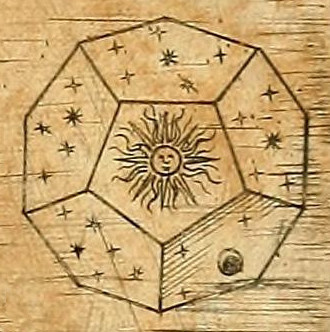
Pythagoras heard the geometry in the ratios of vibrating strings and from the sounds emanating from the work of ancient blacksmiths. Kepler included a dodecahedron filled with stars and the sun at its center in his Harmonices Mundi, published in 1619. Euler mapped a two-dimensional lattice in 1739. Hamilton found a relevant puzzle in 1857, and turned it into a parlor game. Schoenberg organized it into rows. Tymoczko published a paper in Science in 2006 describing musical chords as points in multi-dimensional spaces called orbifolds — and the music theory world called it a tour de force.
Everyone could feel it. Everyone sensed that something was there.
Nobody felt it more urgently than John Coltrane. In the late 1950s and through the 1960s, as he pushed jazz harmony to its outer edges — through Giant Steps, through A Love Supreme, through the free explorations that followed — Coltrane was simultaneously working the problem on paper. He filled notebooks. He drew circles. He mapped pitch relationships by hand, searching for a geometric structure that would unify what his ear already knew. The drawing reproduced below, now held by the Smithsonian, shows how far he got — and where he ran out of tools.
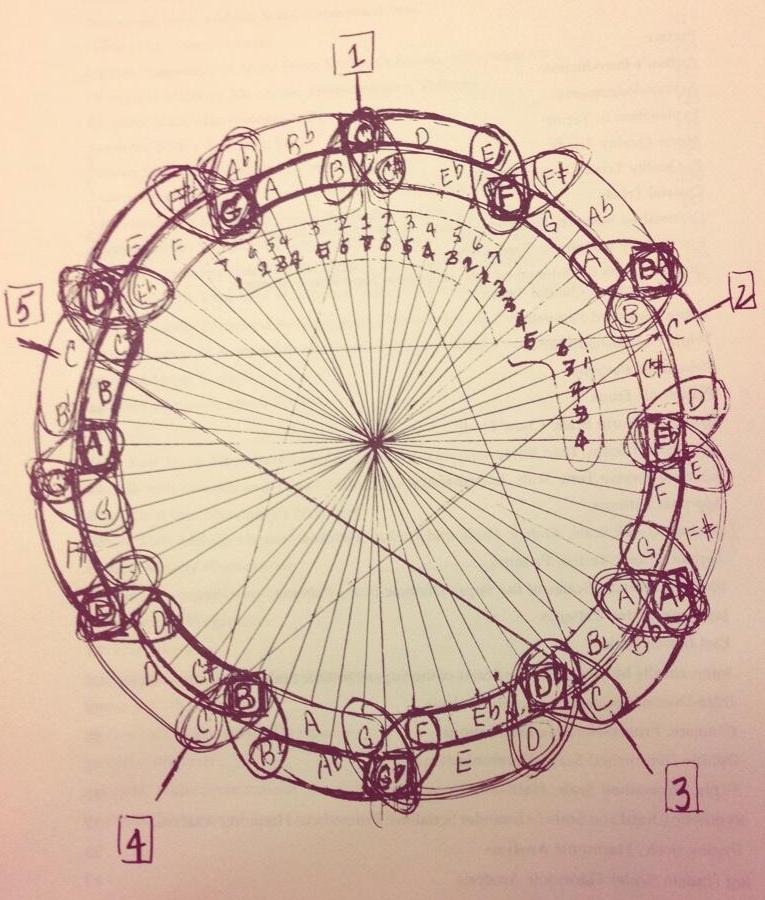
Coltrane's diagram shows the cycle of fifths arranged in a double ring with radial lines connecting intervals across the circle. The five-pointed star — explicit in his groupings — was an attempt to reconcile the pentatonic scale with the larger harmonic cycle. He could hear the relationship. He could not formalize it. The geometry and the mathematics were not yet in hand.
What Coltrane was reaching for — a complete, provable structure in which all twelve tones relate to one another by geometric necessity — is exactly what the Harken Music System delivers. But it would take another half-century, and a different path, to find it.
That path ran first through the Harmonagon — a circle-based music education web application built in 2016, employing position numbers 0–11 and the cycle of fifths as a traversal sequence, that nearly ten thousand musicians found and used. The Harmonagon was a useful tool. But it was built on Western music theory rather than on mathematics. It described what the twelve tones do — it did not ask why the twelve tones have the structure they have. That question, once unavoidable, led somewhere else entirely.
It led to the dodecahedron. And the dodecahedron led to the proof.
When the twelve pitch classes of 12-tone equal temperament are mapped not to the dodecahedron's twelve faces but to its twenty vertices — with natural duplications arising from the geometry of the net — something extraordinary happens. The geometry stops resisting. Every antipodal vertex pair turns out to be a tritone. The ascending and descending traversals turn out to be exact mirror reflections of each other across the tonic-tritone axis. A complete twelve-step Hamiltonian path encodes the harmonic cycle on the solid's surface. The tonic and tritone emerge as the only pitch classes appearing exactly once — the bilateral poles of the solid — not by assignment but by geometric necessity.
Nobody imposed this. The geometry demanded it.
What Coltrane drew by hand in the 1960s, what Orman searched for computationally in 2012, what every serious person who approached this problem could feel but not prove — it was always a dodecahedron. The twelve faces were never the key. The twenty vertices were.
Circling the Mountain
The idea that music and geometry are related is as old as Western philosophy itself. Each generation sensed the shape of something they could not quite see — and each one arrived at a genuine partial truth before running into a wall. One of them drew the right solid. And long before any of them, someone cast it in bronze.
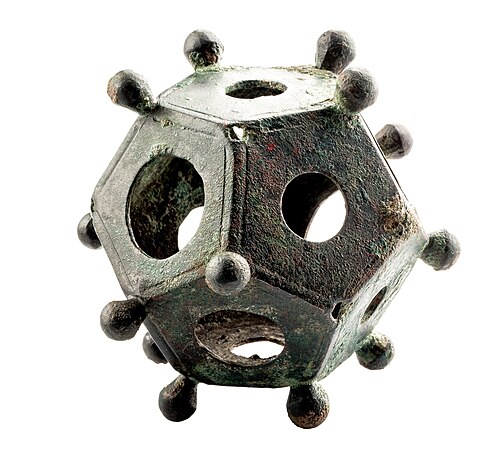
One of approximately 100 found across the former Roman Empire. Purpose unknown — no written Roman source mentions them. The faces are open holes. The vertices are marked with knobs. Twenty vertices. Twenty knobs. They put the emphasis exactly where the proof would eventually require it.
One door closed. One door opened. The gap between Orman's result and the Harken proof is a single decision: vertices instead of faces, and tritones as structure rather than dissonance. The gap between Coltrane's notebooks and the Harken proof is the mathematics he never had.
The Geometric Proof
The Object
The regular dodecahedron has twelve pentagonal faces, thirty edges, and twenty vertices — three faces meeting at each. All twenty vertices lie on a single circumscribed sphere. Its full symmetry group has order 120.
The Antipodal-Tritone Proof
The dodecahedron has ten antipodal vertex pairs — twenty vertices forming ten diameters of the circumscribed sphere. The Harken system proves that in the correct pitch class mapping, every antipodal pair is a tritone — separated by exactly six semitones. This is not assigned. It is proved.
The proof proceeds from the bilateral symmetry of the net. Every pitch class maps to a vertex diametrically opposite its complement, and the complement of any pitch class p is 12 − p (mod 12) — always six semitones away. A tritone. Every time. By necessity.
The Hamiltonian Path and the Cycle Traversal
The Harken system identifies a specific Hamiltonian path on the dodecahedron surface satisfying four simultaneous constraints: it begins at the tonic pole, arrives at the tritone at the exact midpoint, crosses the tonic-tritone axis there, and ends at the bilateral midpoint pitch. No other ordering satisfies all four. The geometry selects it.
The flat map below — a Schlegel diagram, the standard 2D projection of a dodecahedron — makes the surface path visible. Every one of the solid's twenty vertices appears as a colored node, each labeled with its pitch class number. The dashed red path traces the ascending Hamiltonian cycle from tonic (0) through all twelve pitch classes to the endpoint; the dashed blue path traces the mirror surface route. The geometry of the projection preserves every edge relationship of the 3D solid.
All 20 vertices of the regular dodecahedron projected onto a 2D plane, each labeled with its Harken pitch class number (0–11) and colored by the canonical ColorMap. The dashed blue path traces the ascending Hamiltonian surface cycle; the dashed red path traces the descending mirror. Pitch classes appearing at multiple vertices (1–4, 7–10) reflect the natural duplication geometry of the solid's net. The tonic (0, green) and tritone (6, deep red) each appear exactly once — the bilateral poles.
The Bilateral Symmetry Proof
The ascending and descending maps are provably exact mirror reflections across the tonic-tritone axis. The swap rule: 1↔11, 2↔10, 3↔9, 4↔8, 5↔7. Tonic (0) and tritone (6) are fixed — the poles of the reflection axis.
The flat map reveals the geometry. The Harken Galaxy renders it alive. Built as an interactive 3D web application, the Galaxy places all twenty dodecahedron vertices on a rotating circumscribed sphere — each node colored by the canonical ColorMap, each edge a visible interval relationship. The singularity glows at the center. The traversal paths animate across the surface in real time, pitch by pitch, as the solid turns. The proof becomes an instrument. Click the "Start" button below to play the demo app live.
The dodecahedron in three-dimensional space, circumscribed within a sphere. Twenty pitch class vertices glow in their canonical colors; the interior star field of 160 diagonals radiates from the central singularity. Shown here: Tonic C, Structure Dodecaphonic, Traversal Mixed, Direction Ascending — the complete twelve-tone Hamiltonian surface path rendered as a navigable harmonic universe.
The Circumscribed Sphere — A New Musical Cosmology
All twenty dodecahedron vertices lie on a single circumscribed sphere. The dodecahedron is the harmonic scaffolding; the sphere is the true container. The Harken Globe is a new world for 12-TET to inhabit.
The Fifteen Interval Circles
Every interval in 12-TET traces a circle on the surface of the sphere — determined by the plane through the two pitch class vertices and the center of the sphere. All fifteen interval circles are permanently etched on the Harken Globe, each colored by its pitch class blend.
The tritone is the special case: its two endpoints are antipodal, so the plane through them passes through the geometric center. This makes every tritone interval circle a Great Circle — the maximum possible circle on a sphere, a geodesic. There are ten tritone pairs, producing ten Great Circles. The other five interval classes (minor 2nd through perfect 4th) produce smaller latitude circles at their spherical positions.
All fifteen are Interval Circles. Only the tritones are Great Circles — by geometric necessity, not by assignment.
The Singularity
At the exact geometric center sits the singularity — equidistant from all twenty vertices by exactly one radius. It is where all ten Great Circles intersect, where all 160 interior diagonals converge. The tonic in its most fundamental register, radiating outward equally to all twenty vertices. The gravitational anchor of the harmonic universe.
The Interior Star Field
| Class | Diagonals | Count | Character |
|---|---|---|---|
| Small | 4 | 150 | The luminous cloud |
| Medium | 6 | 60 | The middle register |
| Large | 10 | 12 | The densest harmonic points |
| Singularity | 160 | 1 | All pitch classes, one point |
| Total | 223 |
Three Traversal Spaces
The Harken Globe contains three geometrically distinct traversal spaces, each with its own rules:
| Space | Rule | Used For |
|---|---|---|
| Surface | Steps only — adjacent Hamiltonian edges | Scale and cycle traversals |
| Interior (Wormhole) | Direct line through interior — any interval | Interval and arpeggio traversals |
| Pure Interior | All notes connected through interior — no surface contact | Substitution tone rows only |
The interior traversals are wormholes — passages from the 2D curved surface (Flatland) directly through the higher-dimensional space that connects any two surface points. Tritone wormholes pass through the Singularity. All other interval wormholes are interior chords that do not pass through the center.
The Surface as Interior Horizon
There is a subtler truth about the Galaxy's geometry that changes how we hear the whole system. The surface of the dodecahedron is not a boundary that separates the interior from the outside world. It is the horizon of the interior itself — always one step away from any interior point through the diagonal tunnels that already connect every vertex to every other.
This means the surface and the interior are not two separate spaces. They are continuous. A traversal that moves through the interior can reach any surface vertex at any moment. A traversal that steps along the surface is always one diagonal away from the depths. The 12 pitch classes that live on the surface are not locked behind a wall — they are the outermost layer of the same unified harmonic field, permanently accessible from within.
The practical consequence is profound: in the Harken system, all twelve pitch classes are simultaneously available to any traversal at any moment. Nothing is hidden. Nothing is withheld. The only constraint is the set-theoretic rule of the traversal in progress — once a pitch class has been used in a cycle, it steps aside until the tonic calls everything back to begin again. The Galaxy does not limit what is harmonically possible. It reveals the full harmonic universe at once, and gives the traversal rules — not the geometry — the power to shape what emerges.
The 222 interior stars, the singularity, and the twenty surface vertices together constitute a complete harmonic catalog of 243 objects — every one fully described by its position set, shell, IC profile, cycle steps, and hemisphere. That catalog is presented in full in Appendix E. The argument of this essay does not require it; the system does not depend on it. But it is there — every star named by the geometry that created it, nothing borrowed from any prior tradition, nothing left unnamed.
The Fundamental Architecture
The Fixed Tonic
Most Western music theory treats the tonic as contextual — emerging from cadence, repetition, resolution. The Harken Music System makes a different claim: the tonic is fixed, and all other pitch classes are defined relative to it. Position 0 is always the tonic. Position 6 is always the tritone. The labels are permanent. The relationships are absolute.
This is not merely pedagogical convenience — it is geometric necessity. The north pole vertex appears exactly once on the solid. The south pole vertex appears exactly once. The geometry singles them out.
Numbers Over Names
All structures in the Harken system are defined by their tonic-relative pitch class sets. 0,4,7,10 is the primary definition of the dominant seventh chord. "Dominant 7th" is a courtesy label — an on-ramp for those who already speak Western theory. The numbers are universal. They mean the same thing in every musical tradition on earth.
Position Numbers 0–11 — Singing the System
The Harken system proposes that pitch class integers can be sung. A musician sings "zero" on the tonic, "seven" on the fifth, "six" on the tritone. The number is the interval distance from home. There is no translation step. The contraction "'leven" for eleven — the only position number requiring syllabic compression — is documented as a legitimate ear training practice. A small detail that reveals the system was tested by ear, not just on paper.
Traversal Grammar
The Harken traversal system is built on a unified principle: the cycle of fifths is sovereign. Every structure, every traversal order, and every interpolation rule derives from the cycle. Nothing is imported from Western harmonic theory except as a convenient label for familiar structures.
Seven Verified Traversal Orders
| # | Name | Basis |
|---|---|---|
| 1 | Cycle | Pure cycle of fifths |
| 2 | Chromatic | Semitone steps |
| 3 | Mixed | Alternating convergence toward the tritone |
| 4 | Diminished | Minor 3rd stacks — interval: 3-3-3-4 |
| 5 | Augmented | Major 3rd stacks — interval: 4-4-5 |
| 6 | Substitution 2+1 | Block pattern C3-S3-C3-S3 — tone row |
| 7 | Substitution 3+1 | Block pattern C1-S3-C2-S3-C2 — tone row |
Mixed Cycle Interpolation
The mixed cycle alternates between the ascending and descending cycle arms, converging toward the tritone from both directions simultaneously. It is the primary interpolation spine for all structures.
Every structure is defined by its pitch class set. To traverse a structure, walk the mixed cycle and play only the pitch classes that belong to the structure — skip the rest. The skipped notes are picked up in their correct mixed-order position in the interpolation tail when expanding to larger sizes. No pitch class may be used twice. The tonic closes at the octave.
Substitution Tone Rows
Any cycle pitch class may be replaced by its tritone partner — (pc + 6) mod 12. The substitution functions as a chromatic approach note: ascending substitutions lean upward with sharps, descending substitutions lean downward with flats. This is the harmonic geometry of the jazz side-slip and the bebop chromatic approach note — not invented, but explained.
Substitutions must follow a consistent, audible block pattern. Random substitution produces mathematical validity but not music. The ear must be able to track the pattern. Two verified Harken substitution tone rows satisfy this condition:
Substitution tone rows are pure interior traversals — every note connected by a direct wormhole. They do not walk the surface at all. They live entirely in the higher-dimensional interior space, cutting through the harmonic universe rather than walking its curved surface.
The block structure is what makes them musical. Three cycle notes then three substitutions creates a phrase rhythm the ear can follow — the harmonic ground established, then the approach tension, then resolution. This is why bebop works. Harken explains the geometry underneath it.
The Four Symmetrical Scales ⬡ Geometry-Derived
The bilateral symmetry axis of the Harken cycle runs from tonic (0) to tritone (6). A heptatonic scale is symmetrical on this axis if and only if for every pitch class n in the scale, its mirror (12−n) mod 12 is also present. With the tonic and tritone fixed as the axis endpoints, exactly four heptatonics satisfy this constraint.
| Name | Pitch Classes | Skip Pattern | Mirror Pairs |
|---|---|---|---|
| Dorian | 0, 2, 3, 5, 7, 9, 10 | No skips — emerges first, pure | 2↔10, 3↔9, 5↔7 |
| Alpha | 0, 2, 4, 5, 7, 8, 10 | Skips 9 and 3 | 2↔10, 4↔8, 5↔7 |
| Celestial | 0, 1, 3, 5, 7, 9, 11 | Skips 2, 10, 4, 8 | 1↔11, 3↔9, 5↔7 |
| Arabian | 0, 1, 4, 5, 7, 8, 11 | Skips 2, 10, 9, 3 — deepest reach | 1↔11, 4↔8, 5↔7 |
Dorian is unique among the four: it occupies the first seven positions of the mixed cycle with zero skips. It is the natural heptatonic — the one the geometry hands you directly before any skip logic is needed. This is why Dorian has been independently discovered and revered across so many musical traditions globally. It is not culturally privileged. It is geometrically primary.
The four symmetrical heptatonics are the only possible ones. This is a theorem, not an observation. The geometry of the 0-6 axis allows exactly four combinations of mirror pairs — four solutions, no more. Western theory calls Dorian a mode, Arabian scale "Byzantine" or "Double Harmonic," Celestial a variety of "harmonic minor." Harken knows why they are special: they are the four fixed points of the bilateral reflection.
Note that 5↔7 is a mirror pair in all four scales — F and G are always equidistant from the tonic-tritone axis, so any symmetrical heptatonic must include both. This is a geometric constraint, not a musical preference.
Transformation
The Harken Galaxy is not a display. It is a transformation machine.
Every structure in the system — every interval, chord, scale, tone row — exists as a constellation of vertices on the dodecahedron. And because the dodecahedron is a regular solid with full geometric symmetry, every constellation can be subjected to the complete family of geometric transformations: reflection, rotation, inversion, transposition, and any combination of these. The result in each case is a new constellation — a new musical object that is precisely, provably related to the original by the geometry of the solid.
This is not metaphor. It is the mechanism by which the Galaxy generates music.
Reflection
The foundational transformation is reflection. The tonic-tritone axis — running from position 0 at the polestar through the singularity to position 6 at the south pole — is the bilateral axis of the dodecahedron. Reflecting any structure across this axis maps each position p to (12 − p) mod 12, leaving 0 and 6 fixed. This is the ascending-to-descending swap built into the system: the descending traversal is the bilateral mirror of the ascending one, by geometric proof.
But the tonic-tritone axis is not the only axis. Any pair of antipodal points on the dodecahedron defines a valid reflection axis — and there are ten such pairs, one for each antipodal vertex pair. Reflection over the axis defined by position n maps each position p to (2n − p) mod 12. Every axis produces a distinct but geometrically justified version of the original structure.
Consider the structure {0, 7, 5, 2} — positions C, G, F, D. Three reflections, three axes:
Each reflection is a legitimate musical object — not an arbitrary transposition, not a random permutation, but a structure whose relationship to the original is guaranteed by geometry. The three versions inhabit different regions of harmonic space, yet are precisely related. A composer moving between them is navigating the solid's symmetry axes.
Intermediate axes — defined by points between semitones — extend the family further. The discrete twelve positions are samples from a continuous rotational space. The geometry does not stop at the integers.
Reflection Along a Traversal
The reflection axis need not be a static pitch class pair. Any traversal order defines a directed path through the dodecahedron — and reflection along that path generates a corresponding sequence. The reflected structure has the same geometric relationship to the original that a mirror image has to its source, but the mirror is curved along the traversal's route through the solid.
The seven traversal orders are therefore not just playback sequences. They are seven distinct mirrors — seven families of transformations — each producing a different reflected image of any seed structure. Ascending and descending versions of each traversal define two reflection surfaces per order. The combinatorial space is rich, and every point in it is musically meaningful because the geometry guarantees the relationships are real.
The Full Family
Reflection is one transformation in a larger family. The complete set available in the Harken system:
Reflection maps a structure to its mirror image across any axis — the 0–6 bilateral axis, any of the ten antipodal-pair axes, any traversal path, or any intermediate axis between semitones. Every reflection is an inversion of interval content relative to the chosen axis.
Rotation turns the entire constellation around an axis, landing it at a new position on the dodecahedron. In pitch space, rotation is transposition — but transposition made geometric, derived from the solid's symmetry rather than imposed as an external operation.
Inversion — ascending to descending — is the bilateral reflection already built into the system. In the Galaxy, it is not an abstract operation applied to a pitch sequence. It is a physical flip of the solid across its own axis of symmetry, with the traversal path reversing direction.
Traversal substitution applies a different traversal order to the same structure — moving through the same set of vertices via a different surface or interior path. The pitch classes are unchanged; the sequence through them, and thus the melodic shape, transforms entirely.
Compound transformations chain any of the above. Reflect, then rotate. Invert, then apply a different traversal. Each combination is a distinct path through the transformation space — all of it principled, all of it derivable, none of it arbitrary.
Why This Matters
Western harmony has always used transformations — transposition, inversion, retrograde, augmentation — but as compositional techniques applied after the fact, justified by tradition or taste. The Harken system derives them from geometry first. The operations are not techniques. They are the solid's own symmetry group, made audible.
What this means in practice: a musician navigating the Galaxy is not choosing chords from a vocabulary. They are choosing positions and orientations in a transformation space. Moving from a structure to its 3–9 axis reflection is not modulating — it is rotating the solid. Applying a different traversal to the same structure is not reharmonizing — it is choosing a different path through the same constellation. The distinction matters because the geometry constrains the choices. Not every transformation sounds equally close. The solid tells you how far you have traveled.
This is the generative power that the greatest improvisers felt but could not diagram. Coltrane heard it. Monk built entire careers on specific corners of it. The Harken transformation space is where those intuitions live — not as mysteries, but as positions on a solid with a known geometry.
The Galaxy is not displaying music. It is a machine through which music passes — and the machine is a regular dodecahedron, running on the full symmetry group of the most harmonically complete solid in three-dimensional space.
The Generative Engine
The Harken Music System is not only a proof and not only a pedagogical framework. It is a generative engine — a machine that produces music of unlimited variety, guaranteed coherence, and zero arbitrary decisions, driven entirely by parameters operating on geometry.
The distinction from every existing music generation system is fundamental. Sample libraries are finite and curated — you are always choosing from what someone already made. Rule-based systems enumerate permitted moves — the catalog is merely hidden inside the rules. AI generation draws on statistical patterns over a training corpus — every output is a shadow of music that already existed. None of these systems can answer a question that has not been asked before.
Harken can — because the geometry already contains every possible answer, and the parameters navigate directly to it. No catalog. No corpus. No curation. Mathematics responding to settings.
The Two Foundational Decisions
Before any parameter is set, two decisions establish the world in which the engine operates.
The first is the Fixed Tonic — the pitch that will serve as position 0 for the entire composition. This is not a parameter. It is prior to all parameters. The tonic is omnipresent — appearing simultaneously at the polestar, at the singularity, and at one middle-band vertex of the solid — and it never changes. It is the gravitational center from which every position number is calculated, every transformation is measured, and every return is felt as resolution. The machine can never truly get lost because the tonic pole is always there, always reachable in a known number of steps.
The second is the Seed Star — the first harmonic object sounded. Choosing the seed star is like choosing the opening chord or note of a composition: it declares the harmonic world the music will inhabit at the outset. An S5 star opens with consonance and space. An S1 star opens dense and tritone-rich. The singularity opens with everything simultaneously. The seed star sets the tension level, the geometric position, and the implied direction of everything that follows — and from any seed star, the engine knows immediately which transformations bring it home quickly, which push it into novel territory, and how much shift is available before coherence dissolves.
With tonic fixed and seed star chosen, the engine is ready to run. Default parameters produce music immediately. Every subsequent adjustment is navigation.
The Parameters
Eight parameters orient and direct the algorithms. Any combination of settings is valid. There are no wrong configurations — only different regions of an infinite generative space, all of them geometrically coherent.
Symmetry determines which transformation family is active and at what level of the hierarchy. At maximum symmetry — the hemisphere flip across the tonic-tritone bilateral axis — the transformation is maximally audible, producing the strongest sense of departure and return. At minimum symmetry — compound interior transformations chaining reflection, rotation, and traversal substitution — the ear follows the logic subconsciously without being able to name the move. Between these poles lies the full gradient: octant rotation by major thirds (Coltrane's Giant Steps territory), quadrant rotation by minor thirds (the diminished harmonic world), semitone rotation (maximum friction, geometric adjacency). Symmetry is the familiarity-to-novelty dial.
Traversal selects the path through the solid — cycle, scale, mixed, diminished, augmented, or substitution — and determines whether the engine moves along the surface or through interior wormholes. Traversal shapes the melodic character of whatever the engine produces, independently of the harmonic content.
Direction sets ascending, descending, or bidirectional motion. Retrograde is not an external operation applied to a sequence — it is a physical reversal of the traversal path through the solid, with the geometry intact.
Depth controls how far into the interior the engine reaches. Near the surface, the output is harmonically familiar — the well-worn grooves of Western music are surface phenomena. Deep in the interior, the output is novel and surprising — wormhole traversals produce interval combinations that theory either avoided or reserved for the most adventurous improvisers. Depth is the second axis of the familiarity-novelty space, orthogonal to Symmetry.
Density determines whether the engine produces melody, harmony, or both simultaneously — how many voices, how many stars sounding at once, how the traversal is distributed across time and register.
Rhythm sets tempo, duration, and pulse — the time dimension through which the engine moves the parameter space. A fast tempo through a long traversal produces melodic runs. A slow tempo through a dense star produces sustained harmony.
Shift is the algorithmic-to-stochastic ratio. At zero shift the engine is fully deterministic — given the same parameters, it produces the same output every time, reproducible and composable. At maximum shift the engine wanders freely within the current parameter boundaries — bounded randomness that cannot produce an incoherent result because the geometry enforces validity at every step. Intermediate shift values produce the quality that defines great improvisation: intention with spontaneity, logic with surprise.
Size sets the scope of each generative gesture — how many stars, how many steps, how large a structure the engine builds before evaluating its next move.
The Symmetry Hierarchy as Compositional Grammar
Of the eight parameters, Symmetry deserves special attention because it is the parameter most directly responsible for the distinction between the familiar and the novel — and because its behavior depends critically on what is being transformed.
Reflection inverts. Rotation transposes. And sometimes — depending on the structure — the result is the same. A self-symmetric structure, when subjected to its own symmetry operation, returns to itself. The Dorian mode is self-mirroring under the bilateral reflection: apply the hemisphere flip and you land exactly where you started. The diminished tetrad {0,3,6,9} is self-symmetric under rotation by three: transpose it by a minor third and the same four pitch classes appear. The augmented triad {0,4,8} survives rotation by four unchanged.
These self-symmetric structures are the invariant points of the transformation space — where the engine idles harmonically, where stasis is geometrically justified, where the machine can apply operations without moving. They function as pedal points, as pivot structures that belong to multiple transformation paths simultaneously, and as resolution targets where the geometry agrees with itself.
A maximally asymmetric structure, by contrast, moves far under even weak transformations. Every operation on it produces something genuinely new. These are the most generative seed structures in the system — the ones that yield the richest exploration of the parameter space.
The practical consequence: seed structure × symmetry level = actual harmonic distance traveled. A composer who understands this relationship can predict, control, and compose with it. A performer who feels it intuitively is doing exactly what Coltrane did — navigating the transformation hierarchy by ear, without the diagram.
A New Instrument
The Harken generative engine is simultaneously a new musical instrument, a composition tool, and a pedagogical system — and the same engine serves all three without modification.
For the performer, the parameters are the instrument. Adjusting symmetry mid-performance is modulation. Shifting traversal is reharmonization. Increasing shift opens improvisation. Tapping a new seed star pivots the composition. The musician's role shifts from choosing notes to navigating parameter space — which is precisely what the great improvisers were doing intuitively, with the controls unlabeled.
For the composer, the parameters are a notation system for generative intent. A composition is a sequence of parameter states — a score that specifies not individual notes but the geometric conditions under which notes emerge. Every performance of the same parameter sequence is recognizably the same composition while remaining unrepeatable in its details.
For the student, the parameters are a curriculum. Begin with maximum symmetry, surface depth, and zero shift — the engine produces familiar, predictable, audibly logical music. Gradually increase depth, reduce symmetry, introduce shift — the student follows the geometry into increasingly novel territory, with their ear as the guide and the geometry as the guarantee that they are never lost.
No catalog is required. No rules are imposed. The geometry is the catalog. The parameters navigate it. Any setting, any combination, always valid — because the dodecahedron was already there, containing all of it, before the first note was played.
Tonic Shift — The Macro Parameter
There is a ninth parameter that operates at a higher level than the other eight. Where the first eight navigate within a tonal world, this one shifts the world itself.
The singularity — {0,1,2,3,4,5,6,7,8,9,10,11}, all twelve pitch classes simultaneously — never changes its content. But which pitch class occupies position 0 is everything. Rotate the tonic from C to F# and the entire geometric map transforms: what was the polestar becomes the south pole, what was the tritone becomes home, every interior star's position set points to different pitches, the ColorMap realigns, the hemisphere boundaries shift, the entire transformation space reorients around the new center of gravity.
The singularity is the pivot through which every modulation passes. Because it contains all twelve pitch classes, it belongs equally to every key simultaneously. Land on the singularity, shift the tonic, depart — and the engine has modulated through the one point in harmonic space that is native to every tonal world at once. This is exactly how great musicians modulate: they find the moment of maximum ambiguity, where the ear has not yet committed to either key, and move through it. The singularity makes that pivot point explicit and geometric.
Tonic Shift controls whether and how the tonic shifts during generation — the rate, range, and randomness of modulation. At zero Tonic Shift the Fixed Tonic is locked and the compositional world is stable. At controlled Tonic Shift the musician specifies when and to which tonic the engine modulates — a deliberate bridge, a structural key change, a planned reorientation. The geometry makes the distance of any modulation calculable: a shift from C to F# is the maximum possible distance, a hemisphere flip of the entire tonal universe; a shift from C to G is one step on the cycle, the closest possible move. At random Tonic Shift the engine shifts the tonic stochastically within whatever range is set — always passing through the singularity, so the ear never loses the thread entirely.
Tonic Shift is the macro parameter. It changes the coordinate system within which all other parameters operate. A composition with active Tonic Shift is not modulating in the Western sense — it is rotating the entire dodecahedron, reassigning which vertex is home, and letting the geometry recompute everything else automatically.
When the bass player shifts the tonic, the entire band feels it and must follow — or crash and burn. This is not a metaphor. It is geometry. Position 0 moves, and every other player's internal map instantly recalculates, whether they know it or not. The bassist who holds the Fixed Tonic isn't keeping time and outlining chords — they are operating the macro parameter, holding the world steady or, at exactly the right moment, shifting it.
The Bassists Who Held the Geometry
The 1960s and 1970s produced the most rigorous harmonic exploration in the history of Western music — pursued entirely by ear, without a formal geometric framework to stand on. Free improvisation pushed 12-TET to its absolute boundary conditions. The soloists get the recognition: Coltrane's sheets of sound, Ornette Coleman's harmolodics, Cecil Taylor's percussive clusters, Andrew Hill's labyrinthine compositional architectures. But the musicians doing the most structurally essential work were the bassists — holding position 0 while the music dissolved every convention built on top of it.
Jimmy Garrison held the center of Coltrane's classic quartet with a certainty that bordered on the geological. On A Love Supreme, on Crescent, on Meditations, Garrison's role was to anchor the Fixed Tonic so unambiguously that Coltrane, McCoy Tyner, and Elvin Jones had the freedom to go anywhere. The further out they went, the more essential his grounding became. He was the singularity made human — the still point at the center of the cycle while everything orbited around him. Coltrane could ascend as high as he went because Garrison never let go of the ground.
Charlie Haden faced a different and in some ways harder task with Ornette Coleman's quartet. With Coltrane there was always a harmonic framework, however extended. With Ornette there was almost none — just the raw geometry underneath, and Haden's bass finding position 0 in free space, by ear alone, in real time. He wasn't outlining changes because there were no changes. He was locating the tonic by feel, in music that had abandoned every conventional signpost, and holding it there so the music had somewhere to depart from and return to. That required a different order of geometric intuition.
Richard Davis brought a formally educated musician's command — Ellington, Booker Ervin, Andrew Hill — to the same intuitive task. He understood voice leading, counterpoint, and harmonic function at the highest level, and used all of it to arrive at what Garrison and Haden reached by pure ear. Three different paths to the same geometric truth.
Andrew Hill deserves particular recognition. One of the most harmonically original composers and pianists in all of jazz, and consistently underrecognized even within the community that should know better. His Blue Note recordings of the early 1960s — Point of Departure, Black Fire, Judgment — are as harmonically adventurous as anything Coltrane was doing simultaneously, and in some ways more structurally rigorous. Hill was building compositions from harmonic geometry rather than convention, long before anyone had language for what he was doing. Richard Davis was his frequent collaborator precisely because Davis could hear what Hill was constructing and hold its foundation. That partnership was the Fixed Tonic principle in action — Hill ranging freely across the harmonic space while Davis anchored position 0 with enough certainty to make the freedom possible.
None of these musicians had the diagram. All of them were running the correct geometry. The Harken system is the map they deserved to have — and the proof that what they were doing by ear was mathematically exact.
Cycles Within Cycles
The dodecahedron is itself a cycle — the Hamiltonian path departs from the tonic and returns to it. Every traversal is a cycle within that cycle. Every transformation is a rotation of a cycle. Every modulation shifts the center around which the cycles turn. And the singularity — containing all twelve — is the still point at the center of all of them simultaneously.
Cycles within cycles within cycles.
This mirrors how music actually works at every level of scale. A phrase cycles through a handful of stars and returns. A section cycles through a transformation family and resolves. A modulation cycles through a new tonal center and comes home. A composition is the largest cycle — departure and return at the highest level. And underneath all of it, the chromatic cycle itself — the twelve pitch classes arranged in the geometry of the dodecahedron — turning silently, always complete, always there.
This is also why the system feels alive rather than mechanical. Cycles are what living things do — heartbeat, breath, seasons, the orbit of planets. When music follows this same nested cycling geometry, the brain recognizes it at a level beneath conscious thought. It feels natural because it is natural: the same mathematics, expressed in sound.
Kepler felt this. Harmonices Mundi — the harmony of the spheres. He was looking at the same dodecahedron, hearing the same cycles, four centuries too early for the proof.
Transformation as Composition
The engine does not compose by selecting chords from a catalog or applying rules from a style guide. It composes by transformation — geometric operations that convert one position set into another. A composition is a sequence of transformations. The sequence is the composition.
Three pieces of information determine everything:
Fixed Tonic — which pitch class occupies position 0. The anchor. The pole star. Every other position is measured from it. Tonic Shift can move this anchor to a new pitch class, but at any given moment there is exactly one tonic holding the entire harmonic field in place.
Direction — ascending or descending. These are not stylistic choices. They are bilateral mirror states of the geometry itself. Flipping direction applies the swap rule to the entire harmonic field: every position n becomes position (12−n) mod 12, with positions 0 and 6 fixed. What was a major triad {0, 4, 7} becomes a minor triad {0, 5, 8}. The geometry does this, not a rule book.
Size — how many positions in the active structure. A triad is size 3. A seventh chord is size 4. A pentatonic scale is size 5. The Dorian mode is size 7. The full chromatic is size 12. Size determines the density of the harmonic moment.
From these three values, combined with a chosen traversal and transformation type, the engine generates unlimited chord progressions without consulting any external authority. No voice-leading rules. No resolution requirements. No consonance hierarchies. The geometry permits; the engine produces.
This is what replaces Western compositional logic: not a new set of rules, but a space where all paths are valid and the mathematics itself guarantees coherence.
Voice Leading from Geometry
A remarkable emergent property: geometric transformations produce near-optimal voice leading automatically.
Most instrumentalists — especially guitarists — learn chord shapes: grip patterns, finger configurations, fret positions. They move from shape to shape, jumping across the instrument. Common tones that could be held are restruck. Inner voices scramble. The bass leaps unpredictably. The result sounds like a sequence of chords rather than a harmonic flow.
The Harken engine does something different. When a transformation is applied, the minimum necessary change happens. Cycle step +1 advances positions by a fifth — proportional motion, maximum common tones preserved. Direction flip swaps pairs across the bilateral axis while anchors hold. Adjacent structures in traversal order share maximum pitch-class membership by geometric necessity.
This is what Bill Evans did intuitively: moved inner voices by steps while outer frames held, found common tones and let them ring, treated chords not as blocks but as voice streams. He made complex harmony sound inevitable. The geometry produces the same result — not by genius, but by structure.
Consider the mirror transformation: {0, 4, 7} becomes {0, 5, 8}. Position 0 holds. Position 4 moves to 8. Position 7 moves to 5. One geometric operation, and virtually every human ear recognizes the major-to-minor shift. The voice leading is built in. The Galaxy does not know "major" or "minor." It knows the swap rule. The smoothness follows.
A student who learns Harken progressions is not just learning new chords. They are internalizing voice-leading paths that their instrument's layout may have obscured. Over time, the ear starts to expect continuity. The hands start to find the common tones. Isolated grips become positions in a flow. What takes years to develop by trial and error, the geometry makes visible from day one.
The Random Tone Row
Schoenberg's foundational insight was correct: any ordering of twelve tones is a legitimate basis for composition. No hierarchy. No tonic privilege. Every row, valid.
He arrived there by negation — by rejecting tonal hierarchy, by deliberately avoiding triadic resolution, by treating all pitches as equal through force of will. The Harken system arrives at the same place by affirmation — by discovering that the geometry itself contains all orderings without preference.
The mathematics: 12! = 479,001,600 possible tone rows. Every one is a legitimate traversal path. Every one visits all twelve pitch classes exactly once. Every one can drive transformations. The seven named traversals in the Harken system — cycle, mixed, chromatic, diminished, augmented, substitution 2+1, substitution 3+1 — are seven paths among 479 million. The geometry contains them all.
The serial operations Schoenberg codified were geometric operations he could not name:
P (Prime) — the row as selected. R (Retrograde) — the row reversed. I (Inversion) — the swap rule, the bilateral mirror. RI (Retrograde Inversion) — swap plus reverse. These are not arbitrary operations. They are symmetries of the dodecahedron. Schoenberg discovered them empirically. The Galaxy reveals them geometrically.
When the engine selects a random tone row, it is not introducing chaos. It is selecting one fully-determined path from a finite set. The path exists whether named or not. The geometry contains it whether traversed or not. To a being with perfect memory, there is no randomness — only patterns not yet recognized. The dodecahedron holds all 479 million paths simultaneously. The engine accesses one at a time and calls the selection chance. But the geometry was already there. Complete. Waiting.
Schoenberg was right. He just could not see the container. Now we can.
The Ear as Arbiter
The history of music-geometry research is a history of people who could feel the shape of something they could not quite see. Euler felt it in 1739 and built a flat lattice. Hamilton felt it in 1857 and built a puzzle. Schoenberg felt it in the 1920s and built a compositional technique. Tymoczko felt it in 2006 and built a multi-dimensional abstract space. Orman felt it in 2012 and ran a computer search that came back empty.
Everyone was circling the same mountain. Everyone had a piece of the truth.
The Harken Music System arrived not from the academic literature but from a different direction entirely: from playing. From listening. From the musician's instinct for what is fundamental, what holds everything else up, what the root of the chord actually is. From decades of playing jazz and feeling the tritone not as an interval to be avoided but as the axis around which harmony pivots.
When the geometry of the dodecahedron was approached from that direction — with the tritone as structural rather than dissonant, with the vertices rather than the faces, with the ear as arbiter rather than the computer — the solid stopped resisting. The proofs appeared. The system followed.
The Harken Music System is not a theory imposed on music. It is music's own geometry, revealed.
The End of Music Theory as Debate
Western music theory has always been a discipline in which reasonable people disagree — about function, about voice leading, about what the ear actually hears versus what theory claims it should hear. Those disagreements are not incidental. They are structural. A system built inductively from cultural practice will always contain contested zones where the rules run out and taste takes over. The maze was never built with an algorithm. It was built with judgment, generation by generation, from the inside out.
The maze has no ceiling view. Rules were observed, named, codified. Exceptions were noted, then named too. Then exceptions to the exceptions. Every addition — modal harmony, chromatic harmony, jazz extensions, serialism — was another corridor, mapped from ground level, connected to the existing corridors by hand. The system grew richer. It never grew complete. An inductive system built from cultural practice is always chasing the practice, always one generation behind, always adding rooms to the maze.
The deeper problem is that induction from cultural practice imports cultural bias as structural fact. The Western major scale does not occupy its privileged position because the geometry of pitch demands it. It occupies that position because European composers used it for three centuries, and theorists built their system around what European composers did. The result is a theory that cannot distinguish between a universal truth and a local habit. Everything inside the maze looks the same — rule-shaped.
The Harken Music System is built from outside. The dodecahedron is not a musical object that got formalized — it is a geometric object that music was already living inside of, undetected. The tonic is not chosen because it feels like home. It is the pole — one of only two pitch classes that appear exactly once on the solid, structurally distinguished from every other pitch class by the geometry itself. The tritone is not a dissonance that theory has learned to accommodate. It is the antipodal vertex — the point on the solid maximally distant from the tonic in every geometric sense simultaneously. The cycle of fifths is not a useful pedagogical device. It is the Hamiltonian path on the dodecahedron's surface — the only connected traversal that visits every vertex exactly once.
These are not better descriptions of things the maze already knew. They are derivations from a structure that exists independently of any musical tradition. The geometry selects them. Nothing else could.
The practical consequence is the word no prior music theory system can honestly claim: calculable. Given a tonic, a structure, a traversal order, a direction, and a tempo — the output is completely determined. No lookup table. No stochastic element. No editorial judgment baked into a database. No stylistic assumption smuggled in as a rule. Every current music technology falls into one of two categories: systems with libraries, and systems that generate randomly. Libraries are finite, curated, and culturally bounded. Random generation is neither reproducible nor justifiable at the level of individual notes. Neither can answer a question that has not been asked before. Harken can — because the geometry already knows what every unasked question is, and where its answer sits relative to everything else in the system.
Music theory has always been a debate because it has always been an inductive system — and inductive systems, built from taste and tradition, have no algorithm for resolving disputes about what lies around the next corner. A fully calculable system changes the nature of that disagreement. Not every musical question becomes geometric — questions of expression, performance, cultural meaning, and aesthetic value remain exactly where they were. But every question about the structural relationships between pitch classes in 12-TET now has a principled answer available. The Dorian mode is geometrically primary, not because someone finds it pleasing, but because it occupies the first seven positions of the mixed cycle with zero skips — the geometry hands it directly to you before any other heptatonic is reachable. The tritone substitution is not a jazz convention that theory accommodates after the fact. It is the antipodal vertex, and the dodecahedron had it before jazz did.
The maze is not demolished. Centuries of musical knowledge, cultural richness, and analytical tradition remain exactly as valuable as they were. But there is now a ceiling view. And from that view, the maze has a shape, a boundary, and — for the first time — an exit.
From Proof to Practice
A geometric discovery is one thing. A system is another. The same mathematical core — 12-TET modular arithmetic, position numbers 0–11, the canonical ColorMap, the cycle traversal, the fixed tonic — generates a complete family of distinct, working, playable, audible applications. Each is a different view of the same underlying truth.
What Is Genuinely New
The prior art is real. The Tonnetz is a genuine achievement. Tymoczko's orbifolds are mathematically sophisticated. Orman's experiment was correctly motivated. Hamilton had the right object. None of them arrived at what the Harken Music System proves. The gap is not incremental. It is categorical.
The Harken Music System is the first framework to:
- 01Map 12 pitch classes to the 20 vertices of the regular dodecahedron — not faces, not abstract multi-dimensional spaces, not a 2D lattice. The physical vertices of a real Platonic solid.
- 02Prove — not observe, not suggest, not compute — that all ten antipodal vertex pairs are tritones. A theorem. It follows necessarily from the geometry.
- 03Prove that the ascending and descending traversals are exact bilateral mirror reflections encoded in the solid's physical geometry.
- 04Derive a complete, closed, 12-step Hamiltonian surface traversal satisfying four geometric constraints simultaneously.
- 05Identify the circumscribed sphere as the harmonic container with radius equal to one octave.
- 06Establish the singularity at the geometric center as the tonic source — one octave below all twenty surface vertices simultaneously.
- 07Prove that exactly four heptatonic scales are bilaterally symmetrical on the tonic-tritone axis — Dorian, Alpha, Celestial, and Arabian — and explain why geometrically.
- 08Establish 15 Interval Circles on the sphere — the 10 tritone pairs forming Great Circles by geometric necessity, and 5 non-tritone interval pairs forming latitude circles.
- 09Define a complete Traversal Grammar — 7 verified traversal orders, a structure library from intervals through dodecaphonic, and a unified mixed cycle interpolation algorithm.
- 10Produce a fixed, canonical ColorMap functioning as a universal visual language across a complete family of applications.
- 11Make all of this playable and audible in real time — accessible to any musician regardless of mathematical training.
- 12File a provisional patent in January 2026 establishing priority.
Implications
For Music Education
A geometric foundation for interval recognition that is simultaneously visual, auditory, and physical. The ColorMap makes pitch classes instantly distinguishable by sight. The position numbers make intervals countable by ear. The dodecahedron makes harmonic relationships rotatable in space. A student who learns the system in C has learned it in all twelve keys simultaneously — because the geometry is invariant under tonic rotation. Transposition is not a separate skill. It is built into the object.
For Music Theory
The bilateral symmetry proof and the antipodal-tritone constraint are genuine theoretical contributions establishing, for the first time, that the ascending and descending forms of the harmonic cycle are geometrically related — not by musical convention but by the physical structure of the regular dodecahedron. The four symmetrical heptatonics are a provable theorem, not a catalog. Results that belong in the Journal of Mathematics and Music alongside Tymoczko's orbifolds and the neo-Riemannian tradition.
For Mathematics
The identification of the Hamiltonian path with harmonic-cycle constraints, the characterization of all ten antipodal pairs as tritones, the interior star classification of 222 intersection points, and the enumeration of exactly four bilaterally symmetrical heptatonics are combinatorial results that extend the known mathematical properties of the dodecahedral graph.
For Composition
The traversal space is virtually endless. Surface paths, wormhole tunnels through the interior, great circle loops, diametric tritone traversals, substitution tone rows — all geometrically justified, all principled, all discoverable rather than invented. The chromatic approach note and the jazz side-slip are not conventions. They are the substitution tone rows made audible — the geometry of harmony played in real time by musicians who felt the truth long before anyone proved it.
Cubism
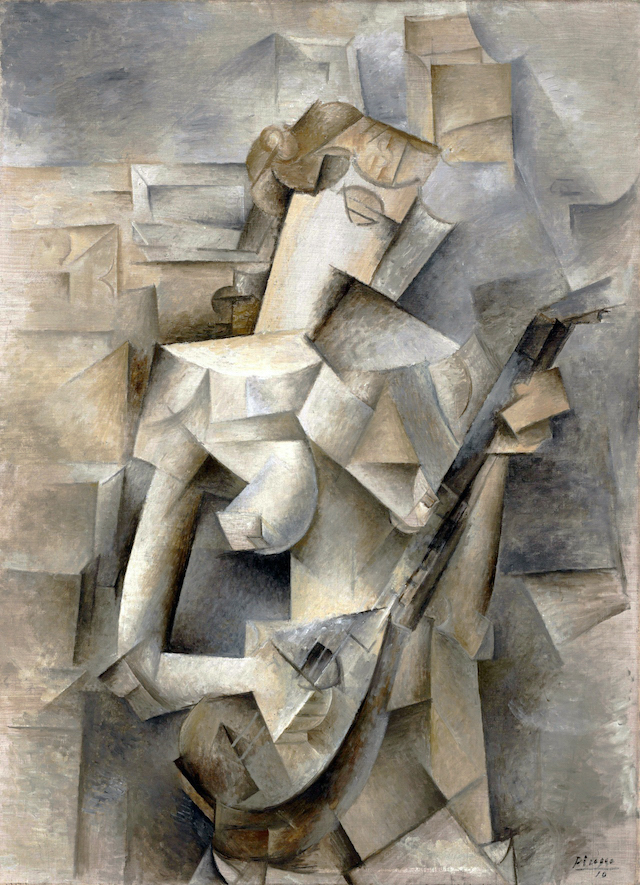

In 1907, Pablo Picasso and Georges Braque began doing something that confused and outraged the art world: they refused the single fixed viewpoint. A face in a cubist painting shows the front, the side, the top, and the interior simultaneously. Not because the painter couldn't render realistically — Picasso could draw with photographic precision before he was a teenager. But because realism was a lie. It presented one perspective as the whole truth, and suppressed everything the single viewpoint couldn't see.
The same refusal was happening in music fifty years later. Coltrane, Monk, Ornette Coleman — they stopped treating one tonal center as the fixed frame of reference and started hearing all twelve pitch classes as simultaneously available, all twelve tonalities as equally real. Not atonality, which is the absence of tonal reference. Something more precise: the simultaneous presence of all tonal relationships at once, with the fixed tonic as the point you choose to stand, not the only point that exists.
This is exactly what the Harken Music System proves geometrically. The dodecahedron shows all twelve pitch classes simultaneously, from all angles, with the interior exposed, the singularity visible, the traversal paths passing through the solid rather than hiding inside it. It refuses the single tonal perspective. It says: all twelve tonalities exist simultaneously in a single geometric space. The tonic is where you stand. The geometry is the same from every vertex.
Picasso and Braque were not the first to feel this. Cézanne felt it before them — that objects have a geometric essence beneath their surface appearance — and said so. The cubists proved it in paint. Coltrane proved it in sound. The Harken system proves it in three-dimensional space.
The 20th century's greatest artists were all circling the same truth from different instruments. The truth had the shape of a dodecahedron all along. It was always a mystery — until now.
"Why then do we love music? Among other things we love it because it creates a physiological well-being in our organism; it is built from materials which are beautiful objects in themselves; it carries us through the realms of creative imagination, thought, actions, and feelings in limitless art forms; it is self-propelling through natural impulses, such as rhythm; it is the language of emotion, and generator of social fellowship; it takes us out of the humdrum of life and makes us live in play with the ideal; it satisfies our cravings for intellectual conquest, for isolation in the artistic attitude of emotion, and for self-expression for the joy of expression."
Reference
A — Harken ColorMap (Canonical)
| Position | Pitch | Color | Hex |
|---|---|---|---|
| 0 | C | ● Green | #339900 |
| 1 | C# | ● Cyan | #00CCCC |
| 2 | D | ● Sky blue | #3399FF |
| 3 | Eb | ● Deep blue | #0033FF |
| 4 | E | ● Indigo | #3300CC |
| 5 | F | ● Purple | #660099 |
| 6 | F# | ● Deep red | #660000 |
| 7 | G | ● Dark red | #990000 |
| 8 | G# | ● Red | #CC0000 |
| 9 | A | ● Orange | #FF6600 |
| 10 | A# | ● Yellow | #FFCC00 |
| 11 | B | ● Lime | #66FF33 |
B — The Seven Traversal Orders
| Name | ASC Sequence | DESC Sequence |
|---|---|---|
| Cycle | 0,7,2,9,4,11,6,1,8,3,10,5 | 0,5,10,3,8,1,6,11,4,9,2,7 |
| Chromatic | 0,1,2,3,4,5,6,7,8,9,10,11 | 0,11,10,9,8,7,6,5,4,3,2,1 |
| Mixed | 0,7,5,2,10,9,3,4,8,11,1,6 | 0,5,7,10,2,3,9,8,4,1,11,6 |
| Diminished | 0,3,6,9,1,4,7,10,2,5,8,11 | 0,9,6,3,11,8,5,2,10,7,4,1 |
| Augmented | 0,4,8,1,5,9,2,6,10,3,7,11 | 0,8,4,11,7,3,10,6,2,9,5,1 |
| Sub 2+1 | 0,7,2,3,10,5,6,1,8,9,4,11 | 0,5,10,9,2,7,6,11,4,3,8,1 |
| Sub 3+1 | 0,1,8,3,4,11,6,7,2,9,10,5 | 0,11,4,9,8,1,6,5,10,3,2,7 |
C — Key Prior Art
The Harmonic Catalog of the Interior
The interior of the Harken Globe contains 222 stars — intersection points of the 160 internal diagonals, organized into four shells at geometrically derived radii. Every one of these stars has a harmonic identity. It is not a chord name or a scale name borrowed from Western theory. It is something simpler and more complete: a set of position numbers, read directly from the geometry.
Each internal diagonal connects two vertices. Each vertex carries a pitch class, assigned by the canonical Harken mapping. When two or more diagonals cross at a point in the interior, the pitch classes at all the vertices those diagonals connect — pooled, deduplicated — form the star's position set. The geometry has already done the harmonic analysis. The position set is the result.
What a Position Set Describes
A position set tells you, without translation, everything harmonically relevant about an interior star:
The positions themselves are the pitch classes relative to the tonic. Position 0 is always the tonic. Position 6 is always the tritone axis. The distance of any position from 0 is its interval above the tonic in semitones. The distance of any position from 6 is its proximity to the harmonic antipode. Every number is an interval and a color simultaneously — the canonical ColorMap makes each position visually distinct the moment you see the Galaxy rendered in three dimensions.
The interval content between all pairs in the set — the IC profile — describes the harmonic weight and tension of the star. Six interval classes, counted: IC1 (semitone, major seventh), IC2 (whole tone, minor seventh), IC3 (minor third, major sixth), IC4 (major third, minor sixth), IC5 (perfect fourth and fifth), IC6 (tritone). The profile is a fingerprint. No two geometrically distinct stars in different shells share the same combination of position set and IC profile.
The cycle steps covered by the set — which positions in the ascending cycle sequence 0→7→2→9→4→11→6→1→8→3→10→5 are present — describe how the star relates to the traversal flow. A star whose positions cluster in the early cycle steps is harmonically close to the tonic. A star whose positions cluster around step 6 is centered near the tritone. A star spanning steps 0 through 11 spans the full cycle and contains the whole harmonic arc.
The hemisphere — tonic-side if position 0 is present but not 6, tritone-side if 6 is present but not 0, neutral if neither, axis-spanning if both — places the star in the geometry of the globe. Tonic-side stars are in the upper hemisphere, pulling toward home. Tritone-side stars are in the lower hemisphere, at maximum harmonic distance. Neutral stars occupy the equatorial middle ground.
The bilateral mirror — the position set produced by applying the swap rule (each position n becomes (12−n) mod 12, leaving 0 and 6 fixed) — is the star's descending-map counterpart. If a star's position set is its own mirror, it is structurally symmetrical on the tonic-tritone axis. The system proves up and down simultaneously: what exists in the ascending catalog exists in mirror form in the descending catalog, by geometric necessity.
Together, these five descriptors — position set, IC profile, cycle steps, hemisphere, bilateral mirror — constitute the complete Harken harmonic catalog entry for any star. Nothing else is required. Nothing needs to be borrowed from any other theoretical framework.
The Shells as Harmonic Strata
The four interior shells are not arbitrary divisions. Each shell corresponds to a specific type of diagonal intersection — a specific number of diagonals crossing at a specific radius — and each shell has a distinct harmonic character that follows directly from its geometry.
| Shell | Stars | Radius | Crossings | Positions | Harmonic character |
|---|---|---|---|---|---|
| S0 — Singularity | 1 | 0.000 | 160 | 12 | All positions simultaneously. The source. |
| S1 — Large Stars | 12 | 0.727 | 10 | 6–8 | Dense, tritone-rich. Six tonic-side, six tritone-side. |
| S2 — Small (inner) | 30 | 1.000 | 2 | 3–4 | Sparse, open. 27% contain a tritone interval. |
| S3 — Medium Stars | 60 | 1.054 | 3 | 5–6 | Rich, complex. 70% contain a tritone interval. |
| S4 — Small (mid) | 60 | 1.183 | 2 | 3–4 | Moderate. 27% contain a tritone interval. |
| S5 — Small (outer) | 60 | 1.434 | 2 | 3–4 | Open, consonant. Zero tritone intervals. The tritone-free zone. |
| SURFACE | 20 | 1.732 | — | 1 | Single positions. The dodecahedron vertices. |
The Singularity — Shell S0
At the geometric center, equidistant from all twenty vertices, every internal diagonal converges simultaneously. The position set is {0,1,2,3,4,5,6,7,8,9,10,11} — all twelve pitch classes, present at once. The IC profile is [12,12,12,12,12,6]: every interval class appears the maximum possible number of times. The singularity does not favor any position over any other. It contains all hemispheres. Its bilateral mirror is itself.
This is not a chord. It is not a scale. It is the harmonic source — the point from which all traversals radiate and to which all traversals return. The tonic in its most fundamental register, one octave below all twenty surface vertices simultaneously. In the Galaxy rendering it glows at the center of the solid, the gravitational anchor of the harmonic universe.
Shell S1 — The Twelve Large Stars
At radius 0.727, the twelve large stars sit closer to the center than any other shell. Each is the intersection of ten internal diagonals — the densest possible interior crossing short of the singularity itself. Each star's position set spans six to eight pitch classes.
The twelve large stars divide cleanly into two groups of six. The first six contain position 0 (the tonic) and no position 6 — they occupy the tonic hemisphere. The remaining six contain position 6 (the tritone) and no position 0 — they occupy the tritone hemisphere. This is not coincidence. It follows from the geometry: the tonic and tritone are the bilateral poles of the solid, and the large stars, lying close to the center, are most strongly sorted by that polarity.
Ten of the twelve large stars contain at least one tritone interval between their positions. Only the two smallest — the six-note sets {0,1,2,3,10,11} and {4,5,6,7,8,9} — are tritone-interval-free, and these two are the only complementary pair in the entire catalog: their union is the complete chromatic aggregate, with zero overlap. Every other large star is harmonically dense and tritone-bearing, its positions spanning most of the cycle.
None of the large stars has a bilateral mirror within the catalog. Their position sets are too large and too specifically determined by the ten-diagonal geometry to be reproduced at any other shell. They are unique to this radius, unique to this density of crossing.
Shell S2 — Thirty Small Stars (Inner)
At radius 1.000 — exactly the radius of the inscribed sphere of the dodecahedron — sit thirty small stars, each at the intersection of two diagonals spanning four vertices. Their position sets carry three or four positions. Twenty-two of the thirty have no conventional name in any musical tradition. They are simply what they are: three or four pitch classes whose geometric relationship is fixed by which pair of diagonals defines them.
Sixteen of the thirty are tritone-interval-free — their positions contain no pair separated by six semitones. Fourteen contain at least one tritone interval. The shell is mixed: neither the harmonic density of S1 nor the clean consonance of S5, but a varied landscape of small position sets at the first substantial distance from the center.
The inner small stars are equally distributed across hemispheres: six contain the tonic, six contain the tritone, and eighteen are neutral — containing neither pole. The geometry at this radius does not strongly favor either hemisphere.
Shell S3 — Sixty Medium Stars
At radius 1.054, just outside the inscribed sphere, sit the sixty medium stars — the harmonic engine of the interior. Each is the intersection of three diagonals spanning six vertices (a combination of two diagonal types the catalog designates D3+D4). Position sets span five or six pitch classes: large enough to carry genuine harmonic complexity, compact enough to be heard as a coherent field of relationships rather than a dense cluster.
Seventy percent of the medium stars contain at least one tritone interval. This is the highest tritone density of any shell except S1. These are the stars a traversal path encounters in the middle depth of the solid — harmonically rich, spanning significant portions of the cycle, with IC profiles that reflect a balanced mixture of all six interval classes.
The medium stars also contain the most recognizable connections to the Harken system's own named structures: several medium stars carry the position sets of the Greek, Alpha, Arabian, and Blues traversal structures — not by design, but because those structures are themselves products of the same geometry. The dodecahedron generated both the named scales and the interior stars from the same underlying mapping. Their convergence at this shell is the geometry recognizing itself.
Shell S4 — Sixty Small Stars (Middle)
At radius 1.183, a second layer of sixty small stars, each again at a two-diagonal intersection spanning four vertices. Position sets of three or four pitch classes. The shell resembles S2 in density but differs in harmonic character: S4 contains a higher proportion of position sets built around fourths and fifths — IC5-dominant structures — reflecting its position between the tritone-rich medium shell and the tritone-free outer shell.
Twenty-seven percent of S4 stars contain a tritone interval, matching the S2 rate exactly. Both shells carry two-diagonal intersections, and both produce the same statistical proportion of tritone-bearing position sets — a structural consequence of the geometry, not a coincidence. Forty-six of the sixty S4 stars have no name in Western musical tradition. They are position sets: three or four numbers, their interval content fixed, their colors fixed, their place in the cycle fixed.
Shell S5 — Sixty Small Stars (Outer)
At radius 1.434, the outermost interior shell before the surface, sit the sixty small stars that constitute what the catalog identifies as the tritone-free zone. Every one of the sixty has zero tritone intervals in its position set. This is not a tendency or a statistical observation — it is an absolute. No star in S5 contains a tritone interval. The geometry at this radius, determined by the specific diagonal type (D2: two diagonals from four vertices), produces position sets that are structurally incapable of containing a tritone pair.
The consequence is audible. S5 stars are open, unresolved, modal in character. Their IC profiles are dominated by perfect fourths and fifths (IC5) and major and minor thirds (IC3 and IC4). Six of the sixty are self-bilateral-mirrors — their position sets are unchanged by the swap rule, symmetrical on the tonic-tritone axis. Nine additional pairs within S5 are bilateral mirrors of each other.
S5 is the transitional shell: the last harmonic territory before the traversal reaches the surface and resolves onto a single pitch class vertex. The opening of the sound, the release of tritone tension, is built into the geometry. As a traversal moves outward from center to surface, it passes through the dense tritone-bearing inner shells and emerges into this consonant outer layer before arriving at the pole.
The Surface — Twenty Vertices
The twenty dodecahedron vertices are the outermost stars: single pitch classes, one per vertex. Twelve of the twenty lie on the Hamiltonian surface cycle — the cycle of fifths traversal path — each appearing exactly once. The remaining eight are the second occurrences of the eight doublet pitch classes: the positions that appear on two vertices each, one on the cycle path, one off it.
Four positions — 0, 4, 6, 10 (C, E, F#, B♭ in the default tonic) — appear on exactly one vertex each. These are the singleton positions: the tonic pole, the tritone pole, and their bilateral partners. Their singularity on the surface has consequences throughout the interior. A singleton position appears in 24.7% of interior stars. A doublet position appears in 42.6% — reflecting the simple geometric fact that two vertices generate more interior crossings than one.
The Catalog Is the System
Western harmony names its harmonic objects — major, minor, dominant, diminished — and builds a system of rules around those names. A musician learns the names, learns the rules, and navigates the harmonic universe by reference to that accumulated vocabulary. The vocabulary is centuries deep. It is also, inevitably, incomplete: the names cover the structures that composers happened to use, in the traditions that got written down, in the cultures whose theory was systematized. Everything outside that tradition is unnamed and therefore, in some sense, uncharted.
The Harken catalog works differently. It does not name objects and then organize them. It derives them. Every interior star is the geometric consequence of a specific set of diagonal crossings at a specific radius. The position set follows by necessity. The IC profile follows from the position set. The cycle steps follow from the canonical mapping. Nothing is assigned. Nothing requires memory beyond the system itself.
A musician who knows the Harken system — the dodecahedron, the twenty vertices, the canonical mapping, the ColorMap, the cycle — can read any interior star directly. The position numbers identify every pitch class at that geometric location. The colors make those positions immediately visible in the Galaxy. The IC profile describes the interval landscape between them. The cycle steps locate the star in the traversal flow. The hemisphere places it relative to the two poles.
This is what it means for a system to be self-describing. Not a library you look things up in. Not a rulebook whose exceptions require additional rules. A geometry from which every harmonic fact can be derived, on the spot, from first principles — the same principles every time, in every key, at every radius, for every star in the field.
The catalog contains 222 interior stars, one singularity, and twenty surface vertices: 243 harmonic objects in total, each fully described by its position set and its place in the geometry. The complete harmonic universe of 12-TET, mapped in three-dimensional space, with nothing omitted and nothing borrowed from any prior tradition.
The dodecahedron already knew all of this. The catalog is simply the record of what the geometry had always contained.
Mathematical Foundations
The Harken Music System builds on established results in geometry, graph theory, and modular arithmetic. These results are not restated here — they are proved elsewhere, by others, and the proofs stand. What follows is a curated map of the mathematical foundations the system rests on, for readers who wish to verify the ground beneath the structure.
Glossary
0→7→2→9→4→11→6→1→8→3→10→5. The descending cycle traverses it in the exact mirror order 0→5→10→3→8→1→6→11→4→9→2→7. The swap rule — replacing each position n with (12−n) mod 12, leaving positions 0 and 6 unchanged — converts one direction to the other with perfect precision. This is a geometric proof, not a musical convention: ascending and descending harmony are reflections of each other because the dodecahedron's bilateral symmetry axis demands it. The cycle is bi-directional by necessity.
0, 7, 2, 9, 4, 11, 6, 1, 8, 3, 10, 5. This is the Hamiltonian surface path on the dodecahedron that satisfies four simultaneous geometric constraints: it begins at the tonic pole, reaches the tritone at the exact midpoint (step 6), crosses the tonic-tritone axis there, and ends at the bilateral midpoint pitch. No other ordering satisfies all four. The ascending cycle is the cycle of fifths, geometrically derived.
#339900); the colors progress through cyan, blue, indigo, purple, deep red, dark red, red, orange, yellow, and lime as positions 1 through 11 ascend. The ColorMap is canonical — it does not change with tonic transposition. In any key, the tonic is always green, the tritone always deep red. The color encodes the position; the position encodes the interval from the tonic; the interval and the color are the same information in two registers simultaneously.
0, 5, 10, 3, 8, 1, 6, 11, 4, 9, 2, 7. The exact bilateral mirror of the ascending cycle. Produced by applying the swap rule to every position in the ascending sequence. The tonic (0) and tritone (6) remain in place; all other positions exchange with their bilateral partners (1↔11, 2↔10, 3↔9, 4↔8, 5↔7).
0, 7, 5, 2, 10, 9, 3, 4, 8, 11, 1, 6 ascending; 0, 5, 7, 10, 2, 3, 9, 8, 4, 1, 11, 6 descending. The mixed cycle is the primary interpolation spine for all structures in the Harken traversal grammar: to traverse a structure of fewer than twelve positions, walk the mixed cycle and play only the positions belonging to the structure, skipping the rest. The Dorian heptatonic is unique in occupying the first seven positions of the mixed cycle with zero skips — making it the natural heptatonic, the one the geometry hands you before any skip logic is needed.
{0, 2, 7} or {0, 1, 3, 5, 8, 10}. In the Harken system, the position set is the name of the harmonic object — no additional label is required or recognized as more fundamental. The set carries all harmonically relevant information: which intervals from the tonic are present, what interval content exists between all pairs (the IC profile), where the set sits in the cycle, and which hemisphere it occupies. Two position sets with different members are different harmonic objects, regardless of any Western naming convention that might assign them the same label.
0,7,2,3,10,5,6,1,8,9,4,11) and Substitution 3+1 (0,1,8,3,4,11,6,7,2,9,10,5). Substitution tone rows are pure interior traversals — every note connected by a direct wormhole through the interior, never touching the surface. They are the geometric basis of the jazz chromatic approach note and the bebop side-slip.
[IC1, IC2, IC3, IC4, IC5, IC6] counting how many pairs in the set belong to each interval class. An interval class is the minimum distance between two pitch classes measured in either direction around the chromatic circle — the smaller of the two possible semitone distances. IC1 = 1 or 11 semitones (minor second / major seventh); IC2 = 2 or 10 (major second / minor seventh); IC3 = 3 or 9 (minor third / major sixth); IC4 = 4 or 8 (major third / minor sixth); IC5 = 5 or 7 (perfect fourth / perfect fifth); IC6 = 6 (tritone — its own inversion). The IC profile is a complete harmonic fingerprint of a position set, independent of transposition or inversion. IC6 specifically counts the number of tritone pairs — the direct measure of tritone tension within the set.
Harken Music acknowledges extensive production and technical assistance by Claude (Anthropic).